

Online Reputation Management: How Google Reviews Can Make or Break Your Miami Business
Before booking a table at a Brickell restaurant, before hiring a plumber in Doral, before walking into a boutique in South Beach — nearly 90% of consumers read online reviews first. In Miami, where competition is fierce and first impressions are everything, your digital reputation isn’t a secondary concern. It’s one of your most valuable business assets.
The question isn’t whether Google reviews affect your business. The question is: are you actively managing your online reputation, or are you letting others define it for you?
Why Miami Is a Market Where Reputation Is Everything
Miami runs on referrals and recommendations. The Latin American and Caribbean culture that defines much of the community has a particular relationship with trust: people buy from those they know, or from those a trusted source recommends. In today’s digital world, Google reviews are that word-of-mouth recommendation — scaled to thousands of people.
The Miami market is also in constant motion. New businesses open every week. New residents arrive from across Latin America and other parts of the United States, searching for trusted local providers. And tourists spend millions of dollars each year based almost entirely on what they see on Google and TripAdvisor.
A 4.8-star rating with 200 reviews can fill your restaurant or salon in record time. A 3.2-star rating with unanswered complaints can sink you — even if your actual service is objectively better than your competitors’.
Google's Algorithm Reads Your Reviews Too
What many business owners don’t realize is that Google reviews don’t just influence customers — they also influence how Google ranks your business in local search results. When someone searches for ‘Cuban restaurant near me’ or ‘best dentist in Coral Gables,’ Google considers your total number of reviews, your average star rating, the recency of reviews, and how actively you respond.
This means actively managing your online reputation isn’t just good for sales — it’s a local SEO strategy directly tied to how many new customers find you on Google every single month.
How to Build and Maintain a Strong Online Reputation
Ask for It and Make It Easy
The number one reason businesses have too few reviews is simple: they never asked. Most satisfied customers don’t write reviews because it simply doesn’t occur to them — unless someone reminds them to.
The ideal moment to ask is right after a positive experience: at the end of a visit, when delivering a completed project, or when confirming that the client is happy. And making it easy is critical: send a direct link to your Google profile via WhatsApp or email, or display a QR code in your location.
Respond to Every Review — Especially the Negative Ones
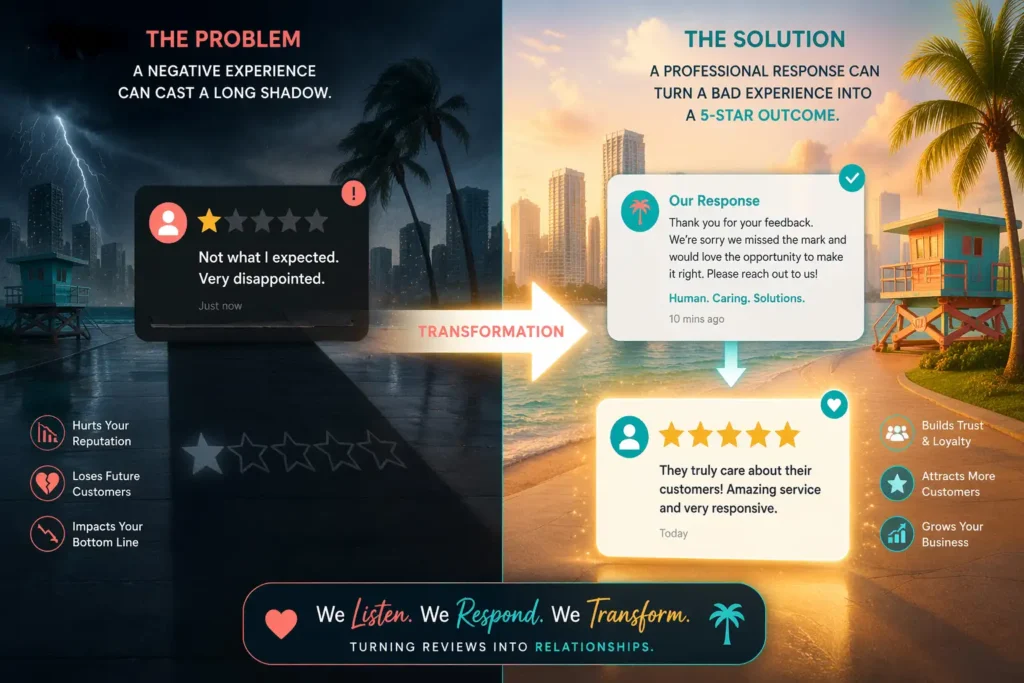
An unanswered negative review sends a clear message: you don’t care. But a negative review responded to professionally, empathetically, and with a concrete solution can become one of your best marketing assets.
The four-step formula for responding to a negative review in Miami:
- Thank the customer for their feedback — without getting defensive.
- Acknowledge the specific issue they mentioned.
- Offer a solution or invite them to contact you directly to resolve it.
- Keep your tone professional and warm — remember, you’re not just responding to that one person, but to everyone who will read the exchange afterward.
Example: ‘Hi [Name], thank you so much for taking the time to share your experience. We’re sorry your visit didn’t meet your expectations. We’d love to understand what happened and make it right. Please reach out to us directly at [email/phone] and we’ll resolve this immediately.’
Consistency Builds Trust
This isn’t about collecting 50 reviews in one week and then forgetting about it. Google rewards consistency: businesses that receive reviews regularly and respond actively rank better than those with many old reviews and nothing recent.
The goal is to build a system that generates reviews organically and continuously: post-service reminders, QR codes on-site, mentions in follow-up emails, and team training to ask for feedback in a natural, non-pushy way.

Fake Reviews: A Real Problem in Miami
Miami isn’t immune to the fake review problem — whether from competitors leaving fabricated negative comments or from businesses buying artificial positive reviews. Both practices violate Google’s policies and can result in profile suspension.
If you suspect you’ve received a fake review, you can report it directly through Google Business Profile. The process isn’t always fast or guaranteed, but Google evaluates each case. In the meantime, the best defense is accumulating so many genuine reviews that one or two fake ones don’t significantly impact your overall rating.
Your Online Reputation Lives Beyond Google
While Google dominates local SEO, your Miami business’s online reputation also lives on Yelp, TripAdvisor (especially for restaurants and hotels), Facebook, Houzz (for design and construction), Healthgrades (for healthcare professionals), and across social media platforms.
A comprehensive online reputation strategy monitors all these channels and responds promptly and consistently across each one.
The ROI of a Strong Reputation
Industry research consistently shows that businesses with 4-star ratings or higher on Google convert between 2 and 3 times more profile visits into calls or physical visits, compared to businesses with 3 stars or below. In Miami, where client acquisition costs through paid advertising can be significant, your online reputation may be the most cost-effective growth strategy available.
At Labrat Studios, we help Miami businesses build and manage their online reputation strategically — from Google Business Profile optimization to review collection systems and reputation crisis management. Your business deserves to be seen. And seen well.